Showing posts with label 18th century bonnets. Show all posts

Thursday, March 8, 2018

White Silk 18th Century Bonnets


For sale at etsy.com/shop/arachneattire.com


White: Believe it or not, the (distant) second most common color for silk bonnets after black in the period including, and surrounding the American War for Independence (Revolutionary War).

Examining Don Hagist's Wives, Slaves, and Servant Girls, I took a tally. I counted, the word "bonnet" mentioned 100 times int he advertisements. The number made calculating percentages rather simple. Out of those 100 bonnets, 69 were black. Eight more were black with colored linings - white, blue, or red. 77% of the bonnets described in the book were black. The next most common color was white with 12, followed by green with 5, and blue with 4.


The book is a collection of runaway ads from American newspapers from the Revolutionary war years, and is very helpful in determining accurate working class portrayals for the period. It is especially helpful, since a great deal of period imagery of women from the years between 1770 and 1783 come from England, and frequently depict upper class women.

Several of the white articles of headwear were called "bonnets" but were described as being made of linen, or cotton, making me wonder if they are what reenactors now call "caps", or if they were brimmed bonnets. Insight on this is appreciated, if you have any.

In any event, I hope my research is useful to someone.


My tally:

1770: Total Mentions of the word "bonnet": 6
Black (3), Black with blue lining (1) White (1) Brown (1)

1771: Total mentions: 7
Black (4) Blue (1) Green (1) White (1)

1773: Total mentions: 10
Black (9) Blue (1)

1774: Total mentions: 9
Black (7) White (1) Green (1)

1775-1776: Total mentions: 36
Black (25) Black lined with white (2) Black lined with blue (1) (2) Green (2) Blue (2) White (4)

1777: Total mentions: 10
Black (7) Black with blue lining (1) Black lined with red or "pale red" (2)

1778-1779: Total mentions: 15
Black ( 10) Black with white lining (1) Purple (1) White (2) Brown (1)

1780-1781: Total Mentions: 11
Black (4) White (3) Black with red lining (1) Green (1) Dove Gray (1) "Reddish worsted" (1)

100 bonnets mentioned.

Black (69) + 8 = 77
- Black with blue lining: (2)
- Black with white lining: (4)
- Black with red lining: (2)


Other Colors: 13 - Green: (5), Blue: (4), Purple (1), Dove Gray (1), "Reddish" (1), Brown (1)

White: (12)


White Silk Bonnets (1752-1782)

English Heritage, Kenwood
Accession Number: 88028844

And check out that awesome blue lining.  Note she wears a white cap under the bonnet.


1773: A decoy for the old as well as for the young

1774: The Invitation.
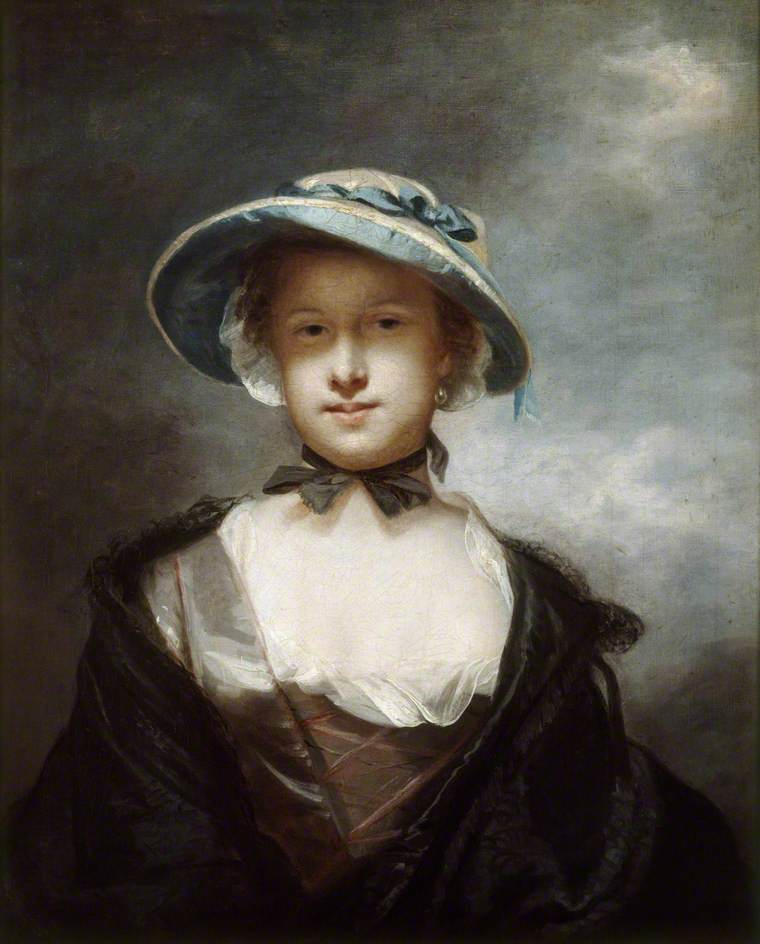
C. 1770 Portrait of Miss Theophila Palmer (1757-1848), niece of Sir Joshua Reynolds, half-length, in a white dress and bonnet Attributed to Sir Joshua Reynolds


1776:  A lovely youth and a Charming Maid. Danceing at the Masquerade.  A satirical print.


National Maritime Museum


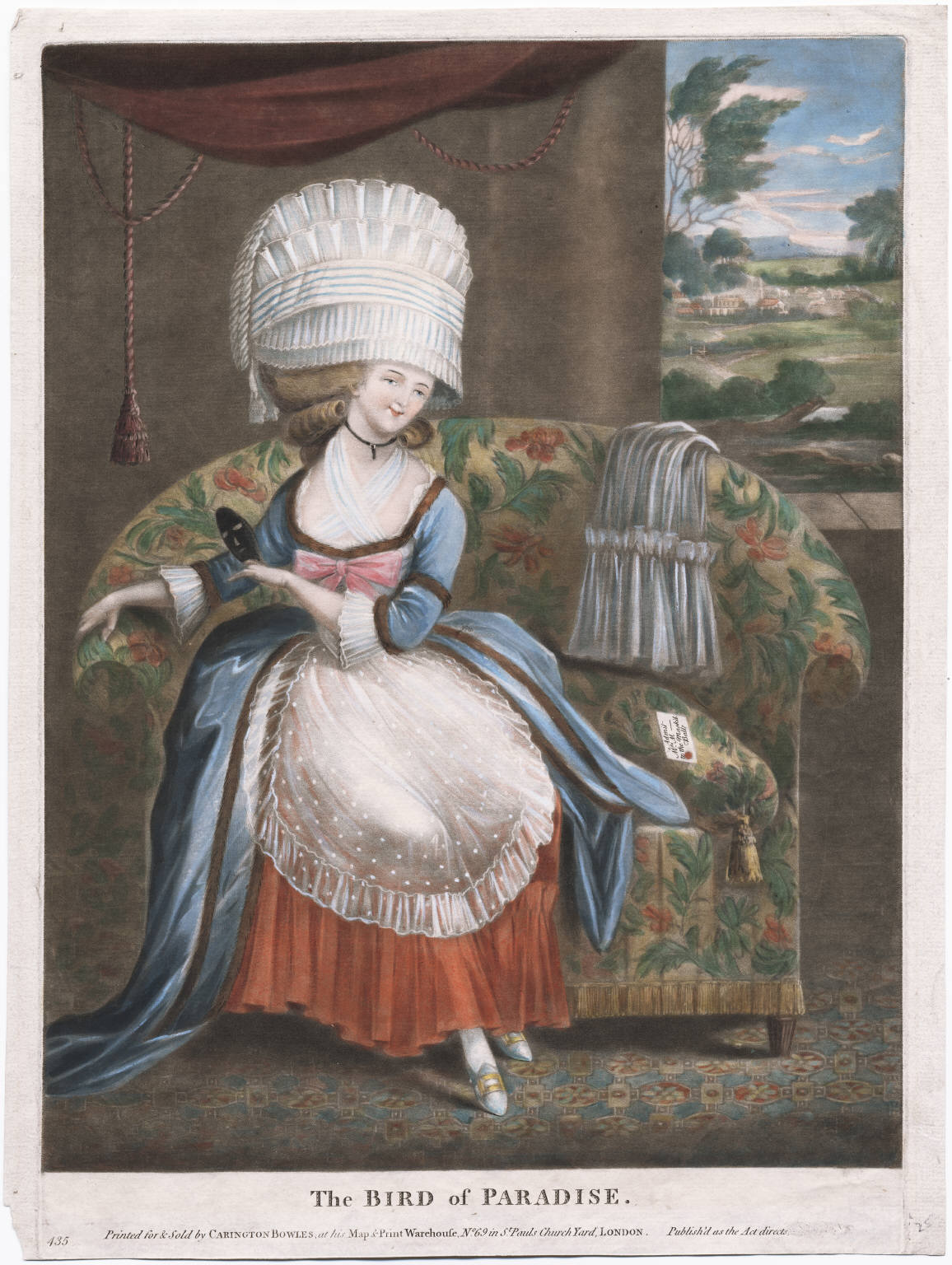
1781: The Bird of Paradise, Yale’s Lewis Walpole Library


Sold to a private collector, Dec. 2000 for over GBP 15,275
Henry Robert Morland was most famous for his portrait of George III.


1780 - Portrait of Anne Howard Vyse by Tilly Kettle (British 1735–1786) Auckland Art Gallery


1780: The woman in the background of 

The Pretty Waterwoman, or Admiral Purblind just run aground by Peggy Pullaway


Runaway Advertisements Featuring White Bonnets: 1770-1782
From Wives, Slaves, and Servants by Don Hagist


1770: Runaway advertisement from the PA gazette: 19 year old Margaret Stephens wore a “white sarsnet bonnet” (Hagist, 11)

1771: Runaway advertisement from the NY Gazette: 26 year old Mary Gordon AKA Mary Dill who was described as “ pale fac’d, down look, takes snuff and much addicted to drink, and a great lyar,”  wore a “white bonnet” (Hagist, 17)

1774: A Runaway advertisement from the VA Gazette.  A “well set Mulatto woman Slave named Bess had among her possessions a “white cotton shift and bonnet” (Hagist, 56)

1775: Runaway ad for Ann Owen in the PA packet.  Ann had a “white apron, bonnet, and cloth shoes.” (Hagist, 77)

1775: Runaway ad Mary Patterson in the Pennsylvania Gazette.  “She had on, and took with her, an old white bonnet…” (Hagist, 78)

1775: Elizabeth Cleland.  Pennsylvania Gazette. “2 bonnets, one black, the other white.” (Hagist, 83)

1776: “mulatto woman named Bess” took a “white cotton bonnet, and one black silk.”  VA Gazette (Hagist, 91)

1776: PA Gazette. An Irish servant woman named Jane Shepherd took “One white halfworn peeling bonnet.”  (Hagist, 96)

1776: PA Gazette.  Irish servant named Margaret Kelly took a “white linen bonnet”.  (Hagist, 104)

1778: PA Gazette.  16 year old servant girl named Olive Oatley took a “white linen bonnet”.  (Hagist, 126)

1778 Royal Gazette NY.  “negro wench, Phillis” took a “white bonnet” (Hagist, 126)

1779 PA Packet.  Servant Mary O’Brien took a “white silk bonnet” (Hagist, 138)

1782: Maryland Journal. 35 year old “negro wench” “A white silk bonnet.”  (Hagist, 153)

1782.  PA Gazette.  15 year old Margaret Morris took a “white linen bonnet” (Hagist, 154)


Saturday, March 3, 2018

She's Back! What I've Been Up to Since 2015

Highlights from The Last Four Years


July 2015: I had a baby!  He's a sweet little handful, and doesn't give me much time to sew, much less blog about it.  Now that he's two and a half, I found myself once again with the time inclination. Here are a few hi lights of various costume projects from the last (nearly) three years.

I've been pretty solidly focused on my day job teaching costume design at an arts magnet high school, and our several productions a year, but I also have been expanding the 18th century millinery operation with my good friend, Ian Graves at Royal Blue Traders.

The sales of these caps and bonnets has been paying for my return to school in an effort to advance my professional credentials.  Thank you to all of our customers, and to Lauren Stowell at American Duchess for the shout-out back when the Hermoine was visiting Virginia in June, 2015.  She featured my shop in her article, The Versatile 18th Century Market Hat.  So thank you, Lauren.  I think I nearly exploded from a fan-girl squee attack when someone pointed it out to me.


Bottle Green Shot Silk Taffeta 1770s Robe A L'Anglaise

2015? My mom's bottle green shot silk taffeta  late 1770s robe a l'anglaise.  She is a tiny stick woman.  It didn't take much fabric.  Now, if only we could get her to wear an 18th century hair dressing...  At least I could convince her to wear stays.

My mom is not a reenactor, or even a historical costume enthusiast, but we do manage to get her to come to a winter ball here and there.  The last few years, my unit, the Ninth Regiment of Foot has hosted a ball at the Hartford Armory's Officer's Club.  Most of my work for myself since 2015 has been for this event, since I don't get the opportunity to dress as a lady too often.


Jan 2015:  Blue Silk Taffeta Shortgown and white striped silk organza petticoat.


 I was five months pregnant, and I wanted to go to the ball, but my options were somewhat limited.  I made a pair of maternity stays, and improvised with a button-front short gown.  The lighting at the Officer's Club isn't the greatest, so getting good photos with an iPhone is always a challenge.


February 2017: Brown Linen English Gown

Attempt #1 with Larkin and Smith's English Gown.  The 20+ page instruction booklet with the detailed photos and diagrams was extremely helpful, but I ended up with way too much volume in the sleeves.  Steph from Larkin and Smith helped me to set them properly when I ran into her at the New England Reenactor Fair in Sturbridge.  Overall, not bad for a first try, but I learned a lot with this gown that I was able to apply to two later versions.  More on this in greater detail later.  Also, American Duchess has a decent article on 18th century sleeve setting.  Setting 18th Century Sleeves the 18th Century Way


July 2017: Attempt #2:  Printed Cotton English Gown


July 2017: The Little One explores his first 18th Century Event with the Ninth Regiment of Foot.  We'll have you marching to the colors in no time, my boy.


Attempt #3: Jan 2018:  The Strawberry Cupcake


The fluffiest of pink cupcakes.  Larkin and Smith's English Gown in strawberry pink silk taffeta.  This  was my second attempt with the pattern, and sleeve issues were more under control, and the fit around the waist was much better.  I also had a lesson in how to pin a stomacher from Hallie and Steph which helped immensely.  Placing the pins horizontally makes all the difference, as does pinning the robing independently of the stomacher.

Caps, Bonnets, and my travels with Royal Blue Traders - The Northeast Reenactor Fair has been good to me these last few years.  Look for us in Portsmouth, NH at the Colonial Trade and Craft Fair at the end of March 2018.


Saturday, November 7, 2015

Help! My bonnet got squished!

I have received a few requests on this subject, so here is a little tutorial to help you fix a squished buckram bonnet brim.

You will need:  A steam iron, ironing board, cotton scrap to serve as a barrier, and a wig head.

First, take the squished brim, and iron using the cotton scrap as a barrier with high steam to dampen and heat up the buckram.  Once the buckram is soft and pliable, roll the brim while you move the iron over it to re-shape the brim.

Once's it's been re-shaped, let it dry and re-harden on the wig head.

The crown of the bonnet can be steamed with a little hand-held steamer to un-wrinkle it.


 I hope this helps, and I hope to be able to make a video at some point.  Happy bonnet-wearing!

Thursday, June 11, 2015

Colors in 18th Century Bonnets

I've been busy busy making 18th century headwear for my adventures with Royal Blue Traders.  I've also been on the hunt for decent evidence of colored silk 18th century market bonnets, and met with some success.  So far, from what I have been able to turn up, the brighter colors, which tended toward blues and greens, were popular in the 1780s, and especially popular for younger wearers.

Blue Bonnets


A Lady and Her Children Relieving a Cottager (1781) by William Redmore Bigg, English, 1755 - 1828
Some very interesting hats in general in this painting.

A Market Girl Holding a Mallard Duck (1787) by John Russell, English, 1745-1806

I made my own version with less fullness, and more of bill-shaped brim in some lovely teal silk taffeta I picked up at Affordable Fabrics in Rocky Hill, CT.  That place is a treasure, but it's real hit-or-miss as to what gems you can find hidden away on the flat-fold remnants tables.  You also really need to know what you're looking for, and have a good handle on how to identify fibers, as nothing is labeled.

My version

Green Bonnets


A Girl Gathering Filberts (1782) by William Redmore Bigg

This spring-ey little piece is a very similar shape to the ones I have been making.  I think I need to re-create one from this portrait with that pink ribbon.


Mrs Ogee, satirical print published by Matthew Darly, 1775

This one features an older lady in a more olive green with blue puffed trim and a wider brim shape.

There is an extremely helpful, extensive list of sources a the Buzz at the Hive.  Especially helpful for the American Revolution period.  Now, on to cranking out more hats in time for the season before the baby arrives!


My version